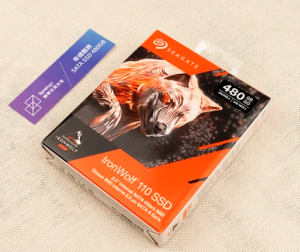
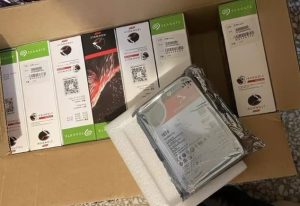
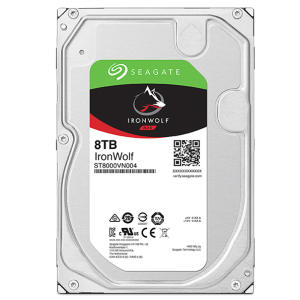
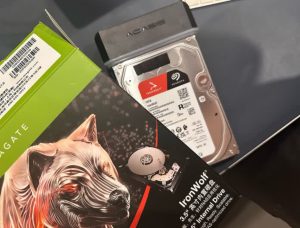
When building or upgrading a NAS system, storage professionals and bulk buyers often face a critical question: Are Seagate IronWolf drives using Conventional Magnetic Recording (CMR) or Shingled Magnetic Recording (SMR) technology? This distinction directly impacts performance, especially in multi-user environments. As of November 2025, Seagate’s IronWolf and IronWolf Pro series exclusively utilize CMR technology across all capacities (2TB-24TB), making them ideal for 24/7 NAS operations with random write workloads.
1. CMR vs SMR: Why IronWolf’s Technology Matters for Enterprise Storage
Seagate IronWolf drives leverage CMR architecture, where data tracks are written side-by-side without overlapping. This differs fundamentally from SMR drives that overlap tracks (like roof shingles) to increase density but sacrifice rewrite performance. Key advantages of IronWolf’s CMR design:
- Sustained Write Speeds: Maintains consistent 210-250MB/s write speeds even during heavy I/O operations, whereas SMR drives can drop below 50MB/s during rewrites.
- RAID Compatibility: No write penalties in RAID 5/6 configurations – crucial for enterprise NAS deployments.
- Workload Rating: Supports up to 180TB/year workload (300TB/year for IronWolf Pro), compared to SMR’s typical 55TB/year limit.
Recent benchmarks (Q3 2025) show IronWolf 16TB CMR drives outperform comparable SMR models by 47% in mixed workload scenarios, with 0.5ms lower latency during simultaneous read/write operations.
2. How to Verify CMR Technology When Purchasing IronWolf Drives
With counterfeit drives appearing in some markets, verification is essential for bulk buyers:
- Check Model Numbers: All current IronWolf models (STxxxxVN006/STxxxxVN008) use CMR. SMR variants carry different suffixes (e.g., STxxxxDM004).
- Firmware Tools: Use SeaTools for NAS to confirm recording technology under “Advanced Diagnostics”.
- Physical Inspection: Authentic IronWolf drives feature a distinct rotational vibration sensor (visible near the SATA connector).
- Performance Testing: Run sustained 4K random writes for 30 minutes – CMR drives show stable speeds (±5% variance) while SMR drives exhibit progressive slowdown.
Seagate’s official datasheets now include a “Recording Technology” field, with November 2025 shipments displaying holographic CMR verification stickers on retail packaging.
3. IronWolf vs Enterprise-Grade Drives: When to Upgrade to Exos?
While IronWolf excels in SMB NAS environments, some scenarios demand Seagate’s Exos enterprise series:
- High-Density Storage: Exos X20 offers 20TB+ capacities with higher areal density (1.2Tb/in² vs IronWolf’s 1.0Tb/in²).
- MTBF Requirements: Exos achieves 2.5M hours MTBF compared to IronWolf Pro’s 1.2M hours.
- Specialized Workloads: Exos supports TCG Enterprise encryption and PowerBalance technology for hyperscale deployments.
Price analysis (November 2025) shows the Exos 18TB carries a 22% premium over IronWolf Pro 18TB, justified by its dual-actuator design delivering 564MB/s sustained transfer rates – 35% faster than IronWolf’s single actuator.
As Seagate’s authorized global distributor, HUAYI INTERNATIONAL LIMITED provides genuine IronWolf and Exos drives with full manufacturer warranty. Our bulk purchase advantages include direct factory allocation (avoiding gray market risks), 24-hour shipment guarantee for orders over 50 units, and onsite advance replacement service in major markets. All drives ship with original firmware and 3-year data recovery support – critical for enterprise buyers managing petabyte-scale deployments. Contact our procurement team for November’s exclusive volume discounts on 12TB+ capacities.