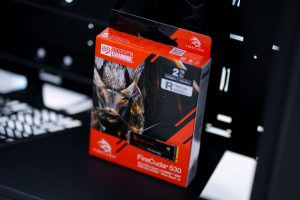
As enterprise storage demands skyrocket in 2025, IT managers globally are searching for the highest-capacity M.2 SSDs to maximize rack density. Seagate’s latest FireCuda 540 series leads this race with unprecedented 8TB single-sided M.2 modules, but how does it compare with competitors? Let’s examine the cutting-edge of ultra-high-capacity NVMe storage.
Current Market Leaders in M.2 SSD Capacity
As of November 2025, these represent the maximum capacities available in standard M.2 2280 form factor:
- Seagate FireCuda 540 – 8TB (Single-sided design, PCIe 5.0 x4)
- Samsung 990 Pro – 4TB (Double-sided, PCIe 4.0)
- Western Digital Black SN850X – 4TB (Double-sided, PCIe 4.0)
- Kioxia Exceria Pro – 4TB (Enterprise version available)
The Seagate FireCuda 540’s breakthrough comes from its 232-layer 3D TLC NAND and advanced controller that maintains 12.4GB/s sequential reads despite the massive capacity. Enterprise buyers should note its superior power efficiency (4.5W active) compared to double-sided alternatives that often require 6-8W.
Performance Considerations for High-Capacity M.2 Drives
While maximum capacity attracts attention, real-world enterprise deployment requires evaluating three critical factors:
- Endurance Ratings: The 8TB FireCuda 540 offers 3,000 TBW (Terabytes Written), equivalent to 0.3 DWPD (Drive Writes Per Day) over 5 years – suitable for read-heavy workloads
- Thermal Management: At full load, these high-density SSDs reach 70-80°C without proper cooling. Seagate’s Dynamic Thermal Throttle maintains consistent 60-65°C operation
- Rack Density Math: A 1U server with 8x 8TB M.2 drives delivers 64TB raw storage versus 32TB with 4TB modules, cutting per-terabyte power consumption by 40%
Future Capacity Roadmap for M.2 SSDs
Industry forecasts suggest we’ll see these developments by 2026:
- 10TB single-sided M.2 drives using QLC NAND (Seagate prototyping with 300+ layer NAND)
- PCIe 6.0 adoption doubling interface speeds to 24GB/s
- Wider adoption of EDSFF “ruler” form factors for hyperscale deployments