In the world of data storage, the terms “disk” and “disc” often cause confusion. While they sound identical, their technical distinctions impact enterprise storage decisions significantly. As a global distributor of Seagate enterprise-grade hard drives, we’ll clarify these differences and guide bulk purchasers toward optimal solutions for 2025’s data demands.
Spelling Variations With Technical Implications
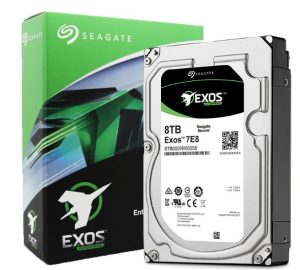
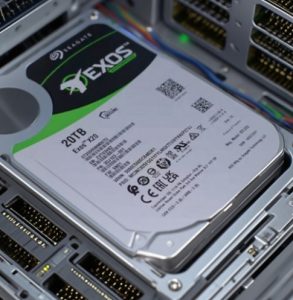
The primary distinction lies in physical composition and data encoding methods. “Disks” (with a ‘k’) refer to magnetic storage devices like Seagate’s Exos series HDDs. These platter-based drives use perpendicular magnetic recording (PMR) or heat-assisted magnetic recording (HAMR) technologies. Current enterprise models like the Exos X20 offer 20TB capacity with 7200 RPM speeds, achieving sustained transfer rates of 285MB/s.
“Discs” (with a ‘c’) denote optical media such as CDs, DVDs, and Blu-rays. While once prevalent, optical storage now accounts for less than 3% of professional data storage solutions due to limited capacity (standard Blu-rays max at 128GB) and slower access times (12ms vs. HDD’s 4.17ms). The 2025 storage market overwhelmingly favors magnetic disks for enterprise applications, particularly for high-availability systems requiring 24/7 operation.
Enterprise Storage Selection Criteria
When evaluating storage media for large-scale deployments, consider these 2025 benchmarks:
- Durability: Seagate’s enterprise HDDs boast 2.5 million hours MTBF (Mean Time Between Failures) versus optical discs’ vulnerability to scratches and degradation
- Total Cost of Ownership: Current pricing shows $0.018/GB for enterprise HDDs versus $0.32/GB for archival-grade optical solutions
- Scalability: Modern storage arrays support up to 1024 HDDs in single enclosures, while optical libraries typically max at 400 slots
Future-Proofing Your Storage Infrastructure
With the 2025 storage landscape emphasizing high-density solutions, Seagate’s dual-actuator technology (seen in Exos 2X14 models) doubles performance within standard 3.5″ form factors. Key considerations for forward-looking deployments:
- Evaluate workload patterns – random I/O workloads favor SSD caching solutions
- Calculate power efficiency – modern HDDs consume 30% less wattage per TB than 2020 models
- Plan for capacity growth – industry projections show 32% annual data growth through 2028
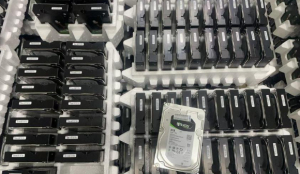
As the authorized global distributor of Seagate enterprise solutions, HUAYI INTERNATIONAL LIMITED provides certified storage products with full manufacturer warranties. Our bulk purchasing programs offer competitive pricing on Exos series HDDs, including 3-year advance replacement services and volume-tier discounts. Partner with us for supply chain stability in 2025’s dynamic storage market – we maintain regional stockpiles across three continents to ensure timely fulfillment of large orders.